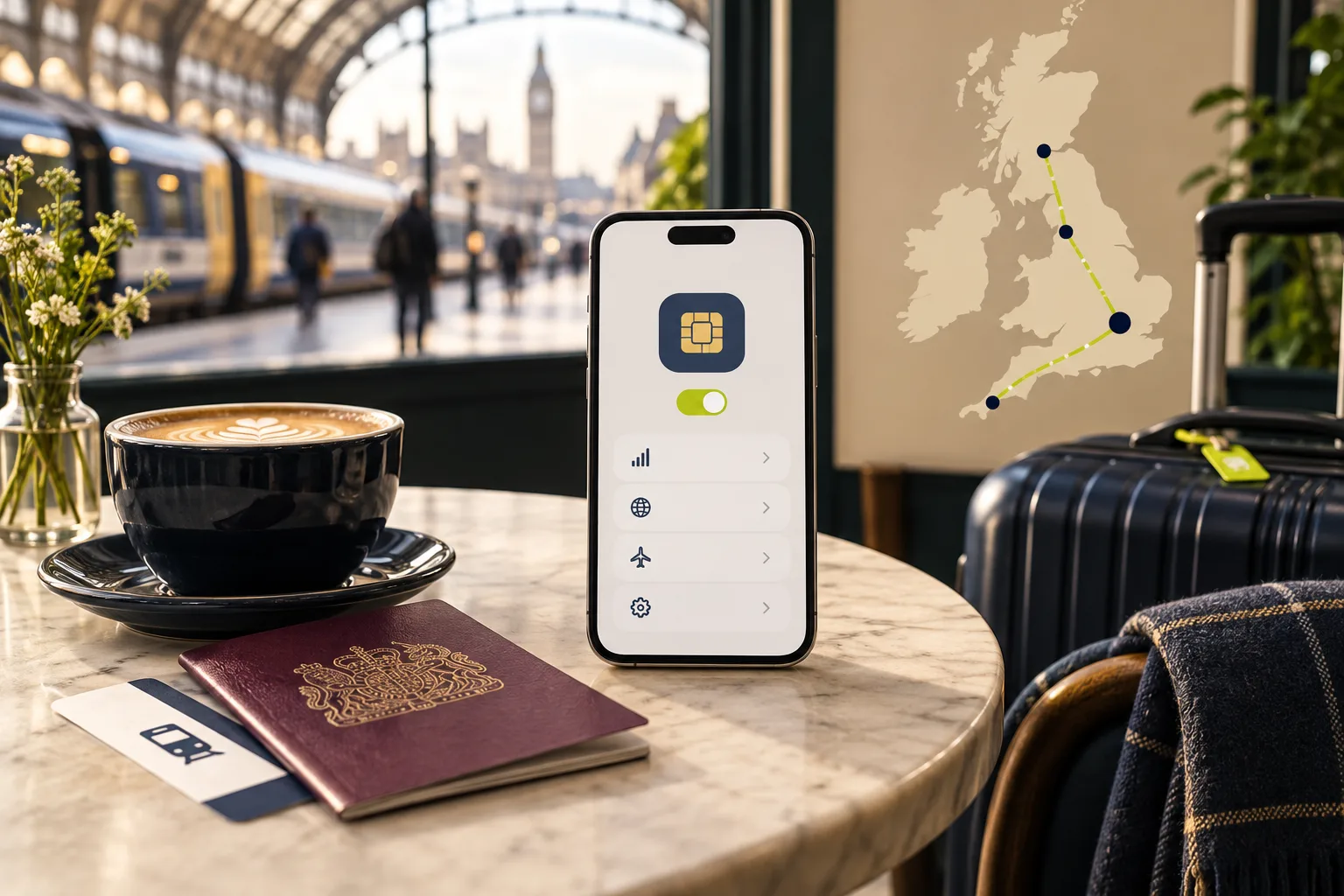
Searching for a travel eSIM for the UK is really a route-and-terms question. A city break, a coast-to-coast itinerary, a mountain stop and an island connection can all place different demands on the same plan. Write down the places you will visit, then compare the eSIM’s current network terms, data model, validity clock and device rules.
The best eSIM for UK travel is the plan whose documented network access covers your actual route, provides enough data for your habits, lasts for the trip and works on your unlocked eSIM-compatible phone. Check city, countryside, Scotland, Wales, Northern Ireland, islands and rail or road transfers separately; a country label is not a promise of service at every stop.
Start with the the UK route, not the plan label
Add airports, transfers, rail or road legs, accommodation, day trips and any location where you need a hotspot. The first city is rarely the whole connectivity question.
| Trip shape | Prioritise | Check before payment |
|---|---|---|
| London or another city break | Data for maps, transit, tickets, translation and messaging. | Allowance, validity and whether the plan’s partner network is usable in the places you stay. |
| England, Scotland or Wales rail route | Coverage beyond one metro area and a validity clock that matches the whole itinerary. | Which partner networks are available outside the largest cities and along the route? |
| Northern Ireland or cross-border itinerary | Country list, partner access and a clear plan for any border change. | Does the plan include every country you will use, and what network terms apply there? |
| Remote work or shared data | High-speed allowance, hotspot permission and recovery support. | Is tethering explicitly allowed, and is it counted against the same allowance? |
This keeps “best eSIM for the UK travel” from becoming a generic provider list. A plan that looks convenient for a capital-city weekend may be a poor fit for a rural, mountain or island route.
Check UK coverage with current evidence
The UK is not one uniform radio environment. Dense urban streets, underground transport, hills, coastlines, buildings and rural roads can produce different results even when a map shows broad coverage. A travel eSIM normally connects through one or more local carrier or roaming partners, so compare the plan’s current partner list with the places you will visit.
For an official reference, use Ofcom’s mobile coverage information and its coverage checker. Ofcom explains that coverage information is based on operator-provided predictions and is updated as information changes. That makes it useful evidence for comparing a route, not a guarantee that a particular travel eSIM will connect in a specific room, train carriage or valley. The Map Your Mobile reference is another way to inspect the current public view.
Download maps, tickets, accommodation details and emergency information offline before a rural or coastal leg. A “5G” label describes a capability or plan condition; it does not promise that the phone will use 5G at every stop.
Compare data, validity and hotspot terms
Estimate how you actually use your phone. Maps, translation, tickets and messaging are different from video calls, streaming, cloud photo backup and laptop tethering. Record the exact allowance and what happens after the fast-data threshold.
- Allowance: write down total or daily high-speed data, not just “unlimited”.
- After the limit: check reduced speed, fair-use thresholds, top-ups and whether service stops.
- Validity: confirm whether the clock starts at purchase, installation or first connection in the UK.
- Hotspot: look for explicit tethering permission if a laptop or companion device needs data.
- Network access: note partner names, 4G/5G access and any selection or speed limits.
Do not choose a long validity window only because it looks flexible. If validity starts at installation, setting up at home may use part of the trip. If it starts at first connection, installing over Wi-Fi can be a useful preparation step. The provider’s current terms decide which interpretation is safe.
Confirm the exact phone before buying
An unlocked phone is not automatically eSIM-compatible, and an eSIM-capable phone can still be carrier-locked or regionally restricted. Check the exact model, regional version, software support and carrier status. Use our eSIM compatibility guide, then verify the unlock status with the carrier-unlock checklist.
Decide which line will carry mobile data after you arrive. Many destination travel eSIMs are data-only, so they do not create a local number for ordinary calls or SMS. A dual-SIM phone can keep the home line available, but data switching, calls and texts on that line may create roaming charges. Set each line deliberately.
Install over Wi-Fi before departure
When the plan allows it, install the profile over reliable Wi-Fi before the flight. Installation and activation can be separate events, so save the provider’s current rule and keep the order details available offline. Do not delete your home line while you are still checking the travel profile.
Save the terms
Record the country list, partner networks, activation trigger, expiry date, support channel and refund boundary.
Install without deleting the home line
Use the eSIM installation guide, label the new line clearly and keep a recovery path.
Switch data after landing
Choose the travel line for mobile data, keep automatic data switching under control and test a simple page before relying on tickets or navigation.
UK travel eSIM checklist
Put two or three candidate plans next to your itinerary and mark unknowns. A missing term is a question for the provider, not an invitation to guess.
| Check | Write down |
|---|---|
| Route | Every city, island, mountain, airport and transfer that matters to you. |
| Network | Partner names, 4G/5G access, selection rules and excluded areas. |
| Data | Total or daily high-speed allowance, fair use, throttling, top-ups and hotspot policy. |
| Validity | Number of days and the exact event that starts the clock. |
| Device | Exact model, eSIM support, carrier unlock, regional restrictions and dual-SIM behaviour. |
| Recovery | Support route, offline order details, maps and a backup contact path. |
That is the useful answer to “what is the best eSIM for the UK?” Choose the plan whose documented conditions fit the route and device you will actually use, then prepare offline information for the places where any network may be limited.
UK travel eSIM FAQ
What is the best eSIM for UK travel?
It is the plan that fits your route, partner network, data habits, validity window and unlocked eSIM-compatible phone. There is no universal winner for every UK itinerary.
Will a UK travel eSIM work in London, Edinburgh and Cardiff?
It can if the plan includes the UK and its partner network reaches those places. Check the current terms and any rural, island or rail stops instead of assuming city coverage applies everywhere.
Do I need a separate eSIM for Northern Ireland?
Not necessarily, but check the plan’s country list and network terms if your route crosses the UK and Ireland. Do not assume a single country label covers every border crossing.
Can I install a UK eSIM before flying?
Often you can install over reliable Wi-Fi, but validity may start at installation or at first connection. Read the activation rule and keep your home line until service is verified.
Does a UK travel eSIM include a UK phone number?
Many travel eSIMs are data-only and do not provide a UK number for ordinary calls or SMS. Check the exact plan if you need voice, SMS or a number.
Reviewed September 17, 2026. Ofcom mobile coverage information, Ofcom coverage checker and Apple’s eSIM and travel guidance.